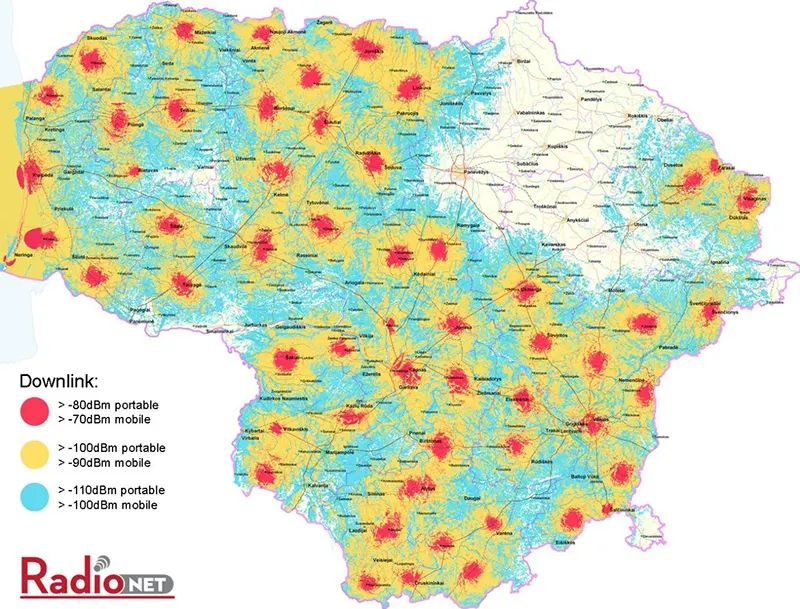
Overview current coverage for mobile and portable radios with 56 base stations
The Dekbera RadioNET network is a two-way radio communication system based on KENWOOD NEXEDGE digital multi-site trunking infrastructure, which will provide continuous coverage throughout the whole country (65,300 km.). This system is backed by KENWOOD’s leading-edge NEXEDGE® digital platform, allowing flexible fleet dispatch communication locally or over a wide area with seamless radio coverage.
System overview
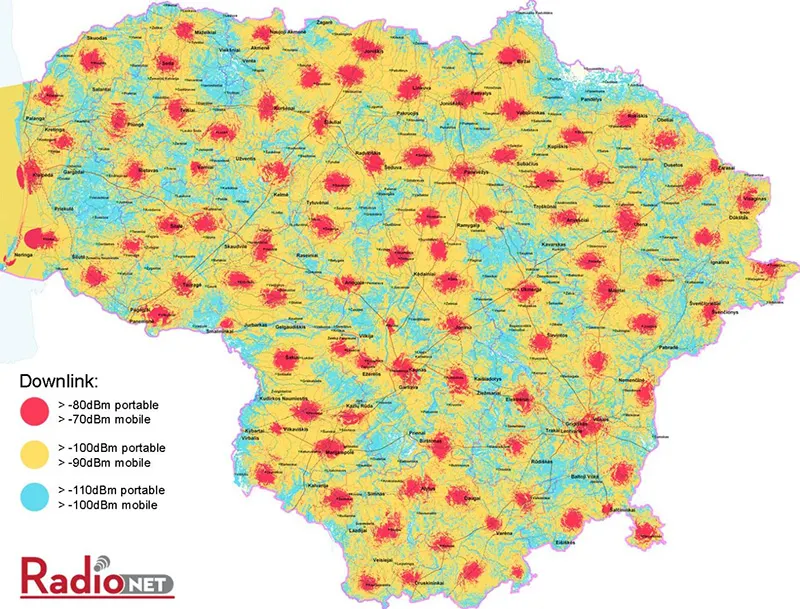
The Dekbera RadioNET network has five stages of implementation. The first stage was fully finished in Spring 2012 and covered the largest (by population) Vilnius region, which has 10 sites and 22 channels. The second stage was completed in the beginning of 2013 and its task was to cover the second largest (by population) central region of Lithuania, which has 16 sites and 39 channels. The second stage includes coverage in the 5 largest cities. The third stage was implemented in the middle of autumn 2013 and covered the regions around the 5 largest cities of Lithuania. The third stage expanded the RadioNET system by 22 sites and 44 channels. By the end of the third stage RadioNET had reached its 48 sites limit, which is the maximum in the first generation of NEXEDGE network technology. Before implementing the fourth stage KENWOOD engineers developed a special system bridge, which allows the end user to connect further NEXEDGE trunking systems. Special firmware was also developed for the radios which allow automatic roaming between two different networks. The fourth stage of implementation was started in December 2013 and will be finished by September 2014. It has three tasks: to cover the 10 largest cities of Lithuania, to in-fill some “network coverage holes” and to expand system capacity. According to the expansion plans for the fourth stage, an additional 27 sites and 70 channels will be installed. As of the end of January 2014 there were 8 sites installed and now the system has 56 sites and 125 channels in total. Currently RadioNET is the biggest NEXEDGE trunking system network in Europe and the biggest network in the world created by a single owner /network provider. The fifth stage should cover the rest of the country, fully in-fill any remaining “network coverage holes” from previous stages and expand the system capacity. The last stage of implementation is planned for 2015 and will add approximately 25 more sites and 75 – 100 channels. In total, RadioNET will have approximately 100 sites and more than 300 channels.
Fifth stage coverage for mobile and portable radios with 100 base stations
Network Backbone Infrastructure Site Description
90% of all sites are installed on GSM operator masts, whose height varies from 60 to 100 metres. Most sites have one 4-dipole antenna on the top of the mast, together with a Combiner system handling 4 repeaters. At the first stage of implementation 1/2″ diameter cables were used, which resulted in high signal losses at the antenna. Currently most of the cables have been upgraded to 7/8″ and some sites already have 2¼” cables. Sites in low-traffic areas near the borders have two 4-dipole antennas on the top of the mast and two Diplexers instead of expensive combining systems. However, currently only 5 sites in the largest cities, where there is more traffic, have 4 channels, a few sites have 3 channels and one main site in Vilnius has 7 channels. Other sites will be expanded with more repeaters. Once this is completed the whole country will be covered and new customers will be invited to join the network.